
Types / Interest types / Realistic · The Doer
RRealistic interest · The Doer
The Tinkerer.
Quick to put your hands on the problem, then understand the system that produced it.
Realistic first, Investigative second.
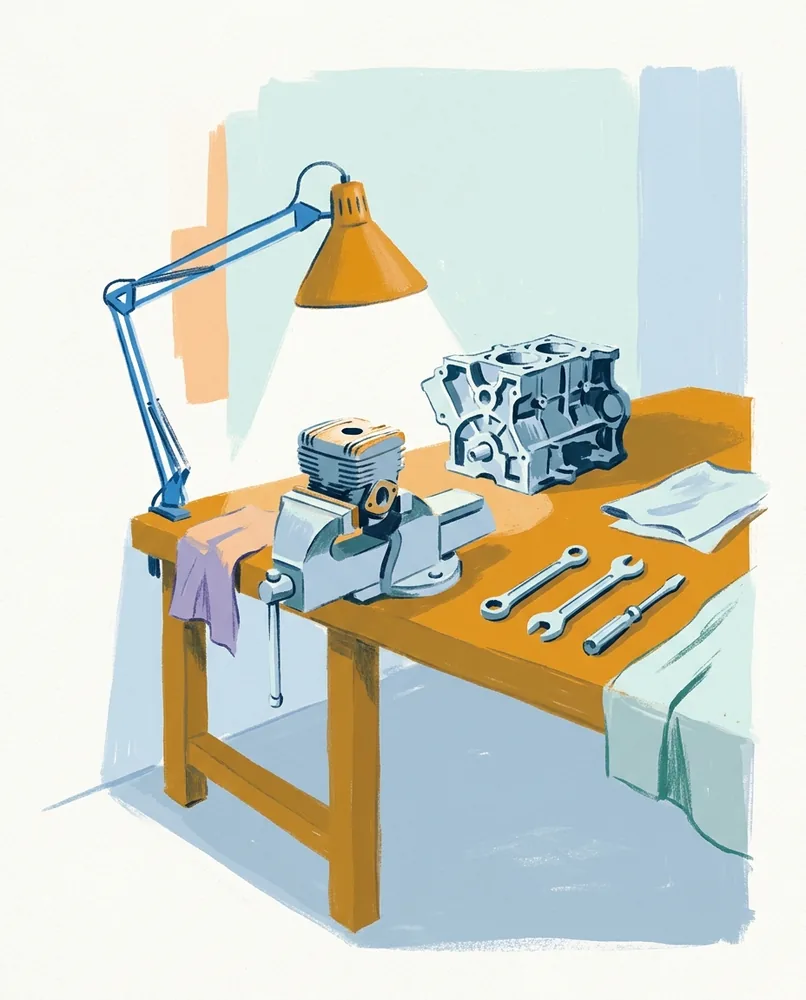
What drives the Tinkerer
When a dishwasher stops halfway through a load, you are unlikely to treat it as a mysterious inconvenience for long. You want the kick plate off, the parts visible, and a way to tell whether the failure is a worn pump, a blocked line, or a symptom of something upstream.
You want the reason, too.
The repair matters, but so does the explanation. A working machine is satisfying; a working machine whose failure now makes sense is better.
At your best
That hands-on curiosity can build durable knowledge.
The trade-off
“Just use it” may feel unsatisfying when you can see an unanswered question inside the casing.
What draws you
This pairing draws you toward problems that are both physical and puzzling: a car that stalls only in the rain, a production line that slips out of alignment, or a robot arm that is accurate until it warms up. You often enjoy the search because every measurement narrows the possibilities. Work such as robotics, equipment testing, fault-finding, surveying, and technical repair can offer that useful combination of tangible consequences and hidden causes.
How you investigate
This mix can make you patient with difficult equipment and impatient with explanations that have not been tested. You are often at your best when a problem needs both a tool and a theory.
How you learn
You often learn objects by interacting with their parts rather than by absorbing instructions in the abstract. A gadget becomes understandable after you open it; a process becomes trustworthy after you test it; a repair becomes memorable after you have made the wrong adjustment and seen what it changed.
About this information
Realistic and Investigative overlap because both take the material world seriously, but they approach it from different directions. The Realistic side asks, “What can I adjust, build, or replace?” The Investigative side asks, “What mechanism explains this?”
Our take Built on O*NET’s descriptions of the work each interest describes[1]. It sketches a mix of interests, so expect some lines to fit you better than others—and use the activities to see what holds up in practice.
O*NET, the U.S. Department of Labor’s job database, says Realistic work involves “designing, building, or repairing of equipment, materials, or structures…” It describes Investigative work as “studying and researching non-living objects, living organisms, disease or other forms of impairment, or human behavior”[1].
How the two letters work together
Side by side on the hexagon
Holland arranged the six interests in a hexagon, placing the ones he considered most alike closest together. Your two interests are next-door neighbors, so they share a natural thread. You may be drawn to work that lets you use both without having to choose between them.
- R
Realistic · The Doer Practical, hands-on work with tools, machines, plants, or animals.
- I
Investigative · The Thinker Observing carefully, researching questions, and working through complex problems.
When strengths overreach
Every strength solves a real problem. When it runs unchecked, the same strength can create a new one. The cards below name the turning point and the cost you may notice.
Chasing the why on a deadline
You want the real cause, and that curiosity can make a lesson stay with you. The same pull may keep you investigating after the useful answer has arrived. If a machine needs to run by five o’clock, you may turn a temporary repair into an afternoon of testing, even when the unanswered question can wait. The cost is time, pressure on the people waiting, and a job that grows larger than the problem. You may notice yourself feeling dissatisfied with a working fix because it explains too little.
Skipping the explanation
At the workbench, you may move through the sequence so quickly that the person holding the flashlight sees only the result. You remove this part, test that connection, and listen for a change in the sound. To you, the logic can feel obvious because each step follows from the last. To someone else, it can feel like unexplained confidence or a request to assist without learning. The repair gets finished, but the knowledge stays with you and the next problem returns to the same pair of hands.
Forgetting who uses it
When your attention locks onto the mechanism, the person using it can fade from view. A device may behave perfectly on a workbench and fail in the hands of someone rushing through a shift, gripping it differently, or working around a small change in routine. You may trust the instrument more than the account of what happened. That can leave the visible fault corrected while the daily problem remains, and the user feeling dismissed by a solution that did not fit their actual work.
Working across interests
See how a strongest interest in Realistic tends to affect the way you work alongside each of the six interests.
- R
Realistic · The Doer
- Where your styles complement each other
- You may both like to see something real get built, fixed, or finished. You may not need much convincing that an idea matters, since you may find the satisfying part in making it work in the world.
- Where your styles may pull in different directions
- You can both end up halfway through a job before either of you mentions you’re doing it two different ways. Shared practicality is useful, but it can also make an unspoken assumption feel obvious to both of you.
- I
Investigative · The Thinker
- Where your styles complement each other
- You get it built and running. They figure out why it behaves the way it does. Together, you can connect practical results with the understanding that makes those results repeatable and easier to improve.
- Where your styles may pull in different directions
- You might be ready to flip the switch and see what happens before they have finished working out why it should work. Your willingness to learn by doing can move things forward, while their caution can keep a quick result from becoming a hard-to-explain problem.
- A
Artistic · The Creator
- Where your styles complement each other
- They picture how it could look or feel, and you know what it’ll take to actually make it. Their sense of possibility can give your practical skill a more memorable direction.
- Where your styles may pull in different directions
- Your eye may go to what is sturdy and built to last, while theirs may go to what is new or expressive. You may protect the idea from becoming impractical, while they may protect the practical answer from becoming forgettable.
- S
Social · The Helper
- Where your styles complement each other
- You build or fix the thing. They keep the people it’s for in mind. That combination can turn a technically sound result into something people can actually use and trust.
- Where your styles may pull in different directions
- They may want to talk it through when you might rather get started. Their questions can reveal a person’s real need, while your action can keep care from becoming an endless discussion.
- E
Enterprising · The Persuader
- Where your styles complement each other
- They make the case and line up the backing. Then you make it real. Their energy can create an opening for your practical judgment, while your work gives their promise something solid behind it.
- Where your styles may pull in different directions
- They might promise a finish date or result before you have seen what the job involves. Their confidence can attract support, while your reluctance to promise too soon can keep that support from being built on wishful thinking.
- C
Conventional · The Organizer
- Where your styles complement each other
- You may do the hands-on work, while they may keep the records, parts, and schedule in order. You can bring contact with reality, while they can make that work dependable enough to repeat.
- Where your styles may pull in different directions
- When the manual says one thing and the machine in front of you says another, you might trust the machine while they may reach for the manual. Your experience can catch what instructions miss, while their process can prevent one unusual case from rewriting the whole method.
These interests describe the kinds of work people are drawn to, not how anyone handles closeness or conflict.[2]
With other people
At work
What may feel easy
Work can feel straightforward when it gives you something real to inspect and a question worth answering. People with Realistic or Investigative interests often respect the same evidence: the tool either fits, the system either holds, and the explanation either survives a closer look. You can spend a day taking something apart, tracing the failure, and testing a better version without needing agreement or ceremony. That shared attention makes quiet feel productive instead of awkward. A promising idea may receive less attention if its value is not yet visible in a working model.
With this pairing, “Can I try it?” and “How do we know?” can belong in the same conversation. One person moves toward the hands-on test; the other protects the reasoning behind it. At its best, the partnership produces more than a working result: it produces a result you can explain, improve, and trust.
Where friction may show up
The friction often appears when someone measures progress through people, persuasion, or process. A Social coworker may ask who will use the solution and how it affects them; an Enterprising coworker may ask who is sponsoring it, what it will achieve, and when it can move. You may still be testing how the thing works while they are deciding whether anyone will adopt it. Their questions can sound like distractions from the real work. To them, the human response and the practical outcome are part of what makes the work real. Your strongest answer may be to connect the evidence to a consequence: what the solution changes, for whom, and why that makes further testing worthwhile.
What they might bring
Bring the people who will use the outcome into the room early, along with enough backing to build and test it properly.
When you are much alike
Two people with this interest type can create a quieter problem: both may trust independent investigation so much that coordination feels unnecessary. Each starts testing a different version, follows a different clue, or assumes the other will speak up if something matters. By the time the mismatch becomes visible, both have invested in work that may be sound on its own but incompatible together.
Research behind this panel
A meta-analysis of work groups found that conflict about each other, or about how the work gets done, went with worse group results, while disagreeing about the task itself was not strongly tied to worse performance[C22]. A team can challenge an idea without attacking a colleague. The distinction becomes harder to maintain when criticism is vague, personal, or tied to status.
People included in the research
Research on teams mixes real workplaces with student project groups, so treat it as a rough guide. A team is also influenced by its manager, incentives, workload, power differences, and whether people have room to work in their own way.
As a friend
What may feel easy
Friendship can feel easy when it has room for shared curiosity and unforced quiet. A Saturday spent rebuilding a carburetor, tracing a sourdough failure, or learning why a plant is struggling gives you something to notice together without requiring constant conversation. You may show care by remembering a useful detail, finding the right tool, or helping solve the problem. The friendship deepens through attention to a shared subject rather than through continuous emotional narration.
Where friction may show up
A friend who builds closeness through dinners, group plans, and frequent check-ins may keep inviting you out while you are absorbed in a project. You may experience the invitations as pressure and answer with a vague “maybe,” while they experience the vagueness as disinterest. Two people with this pattern can create the opposite gap: each assumes the other is content with silence, and neither notices that the friendship is being maintained mostly by memory.
What they might bring
Bring new people and new experiences into the workshop of your life, along with a reason to put the tools down once in a while.
Research behind this panel
In two studies of new acquaintances, more hours together went with growing closer, and leisure time together went with closeness too[C23]. Familiarity creates opportunities for trust, but time alone is not magic: repeated contact is more likely to help when people feel welcomed rather than trapped, evaluated, or ignored.
People included in the research
Most friendship studies so far have looked at students. Friendships later in life can carry different pressures, histories, and choices about time, so treat these findings as a starting point rather than a complete picture.
In a relationship
What may feel easy
A partner who is comfortable with a half-built project on the dining table—and perhaps curious enough to help—may feel like a natural fit. Shared work can become shared time: one person handles the practical step, the other follows the question, and both enjoy watching something take shape. The important ease is not identical interests. It is the absence of a demand to perform closeness every minute.
Where friction may show up
Someone whose evenings run on people and plans may read a weekend in the garage as time away from them, even when you mean it as restoration. A partner with interests much like yours may create a different blind spot: both of you can feel close simply by being nearby, while important feelings, logistics, or disappointments remain unspoken. Shared quiet is nourishing only when neither person is using it to avoid the conversation the relationship needs.
What they might bring
Bring a wider circle and a habit of telling your partner about what you are making, not only showing the finished result.
Research behind this panel
In one study of married couples, whether time together went with satisfaction depended on doing things both partners liked[C25]. Being together is not automatically nourishing. Shared time works better when neither person is consistently performing the other’s idea of fun, and when both can sometimes choose the activity.
People included in the research
Most of this research studied married, heterosexual couples in Western countries. One study of the push-pull loop included lesbian and gay couples and found the same link[C12]. Use these findings as useful but incomplete clues, not as a definition of what a relationship should look like.
How a third letter can shade it
A full interest code has three letters. The third is a supporting interest, something to hold on to alongside RI. It may not lead your choices, but it can influence the setting, problems, or people that make the work feel worthwhile.
-
RIARIA
Artistic third
Some room for your own ideas, imagination, and a way of doing things that’s distinctly yours.
-
RISRIS
Social third
Time spent directly with people, whether that’s teaching, helping, encouraging, or looking after someone.
-
RIERIE
Enterprising third
A chance to lead something, make the case for it, negotiate for support, or move it forward.
-
RICRIC
Conventional third
Clear plans, tidy systems, and dependable follow-through, so everyone knows what’s happening and who’s doing what.
Where RI tends to fit
Here are example jobs with this mix of interests, from O*NET[1]. They are possibilities to investigate, not recommendations. A title can fit your interests while the daily setting, training path, pay, or demands do not fit your life. Each link opens the occupation’s page on O*NET OnLine, where you can explore the work in more detail.
- Automotive Engineering Technicians (opens O*NET OnLine in a new tab)RIC
- Veterinary Technologists and Technicians (opens O*NET OnLine in a new tab)RIC
- Environmental Engineering Technologists and Technicians (opens O*NET OnLine in a new tab)RIC
- Precision Agriculture Technicians (opens O*NET OnLine in a new tab)RIC
- Chemical Engineers (opens O*NET OnLine in a new tab)RIC
- Electronics Engineers, Except Computer (opens O*NET OnLine in a new tab)RIC
- Agricultural Technicians (opens O*NET OnLine in a new tab)RIC
- Automotive Engineers (opens O*NET OnLine in a new tab)RIC
- Civil Engineers (opens O*NET OnLine in a new tab)RIC
- Robotics Engineers (opens O*NET OnLine in a new tab)RIC
This page includes information from the O*NET 31.0 Database by the U.S. Department of Labor, Employment and Training Administration (USDOL/ETA). Used under the CC BY 4.0 license. O*NET® is a trademark of USDOL/ETA. Nomigram has modified all or some of this information: scores are rounded and only some fields are kept. USDOL/ETA has not approved, endorsed, or tested these modifications. Credits and licenses
The other Realistic types
All 30 interest types →- RARealistic
The Maker
someone who comes alive when a physical thing becomes both useful and unmistakably yours.
- RSRealistic

The Mender
someone who finds practical work most worthwhile when a real person is better off because you did it.
- RERealistic

The Wrangler
at home turning practical work into an organized effort—from the materials to the people to the finish line.
- RCRealistic
The Mechanic
Fond of a tidy toolbox, a dependable method, and a job done carefully enough that the next person can trust it.
Take the Career assessment and find your type
Rate 30 work activities to identify your interest type. Then see what draws or drains you at work, which jobs to explore, and where a strong interest can narrow what you consider.

Questions
What makes two people easy to be around?
Similarity is less powerful than most compatibility charts suggest. In national studies of married couples in three countries, the resemblance between two people’s personalities explained less than half a percent of relationship satisfaction after each person’s own traits were counted[C1]. Two studies of friends found a similar pattern[C5][C6]. Being alike may make recognition easier, but it does not automatically create trust, care, or a workable daily life.
What each person brings mattered more. Warmth, reliability, and staying steady under stress were linked with the other person’s greater satisfaction[C1][C2]. And the relationship people were actively creating mattered most. Across 43 studies that followed couples for between 2 months and 4 years, feeling appreciated by a partner and believing that partner was committed predicted how the relationship was going better than any personality trait did[C3]. A trait may influence a tendency; repeated responses teach the other person what it is safe to expect.
So read what follows as a set of places to look, not a verdict about a bond. Notice what feels natural, what gets misread, and what each person has to learn to make visible. People also change. In long-term studies in two countries, being in a first serious relationship went with becoming calmer over the years[C33][C34]. A relationship is not only a meeting of two finished personalities; it is also an environment in which habits can strengthen or soften.
Can this tell whether two people will get along?
No. Assessments cannot yet predict whether two people will get along, fall for each other, or last. In two speed-dating studies, more than 100 answers given beforehand could not predict who would be drawn to whom in particular[C7]. A report can offer language for a conversation, but it cannot account for timing, shared circumstances, attraction, repair after conflict, or the many small choices that make someone feel valued.
Can I read this about someone I know?
You can, but treat it as a set of possibilities rather than a description you can assign from a distance. A type page describes a mix of scores, and the person may experience that mix differently from how it looks to you. Ask what fits, what does not, and what you may have been interpreting too quickly.
Where does this come from?
The numbered sources match the table on our method page. The personality statements come from the public-domain International Personality Item Pool, and the percentiles compare your answers with a published open data set of several hundred thousand people. The ones marked C are the studies behind “With other people.”
- 1 O*NET OnLine, U.S. Department of Labor. Career interest definitions and occupation interest codes.
- 2 Nauta, M. M. (2010). The development, evolution, and status of Holland’s theory of vocational personalities. Journal of Counseling Psychology, 57(1), 11–22.
- 6 Nye, C. D., Su, R., Rounds, J., & Drasgow, F. (2017). Interest congruence and performance: Revisiting recent meta-analytic findings. Journal of Vocational Behavior, 98, 138–151.
- 8 Hoff, K. A., Song, Q. C., Wee, C. J. M., Phan, W. M. J., & Rounds, J. (2020). Interest fit and job satisfaction: A systematic review and meta-analysis. Journal of Vocational Behavior, 123, 103503.
- C1 Dyrenforth, Kashy, Donnellan & Lucas (2010). Journal of Personality and Social Psychology 99(4), 690–702. Abstract only DOI
- C2 Malouff et al. (2010). Journal of Research in Personality 44(1), 124–127. Abstract only DOI
- C3 Joel et al. (2020). Proceedings of the National Academy of Sciences 117(32), 19061–19071. Read the full article DOI
- C5 Yang et al. (2026). Social Psychological and Personality Science. Abstract only DOI
- C6 Körner & Altmann (2023). Journal of Research in Personality 107, 104436. Abstract only DOI
- C7 Joel, Eastwick & Finkel (2017). Psychological Science 28(10). Abstract only DOI
- C12 Baucom, McFarland & Christensen (2010). Journal of Family Psychology 24(3), 233–242. Abstract only DOI
- C22 de Wit, Greer & Jehn (2012). Journal of Applied Psychology 97(2), 360–390. Abstract only DOI
- C23 Hall (2019). Journal of Social and Personal Relationships 36(4), 1278–1296. Abstract only DOI
- C25 Crawford, Houts, Huston & George (2002). Journal of Marriage and Family 64(2), 433–449. Abstract only DOI
- C33 Neyer & Asendorpf (2001). Journal of Personality and Social Psychology 81(6). Abstract only DOI
- C34 Lehnart, Neyer & Eccles (2010). Journal of Personality 78(2). Abstract only DOI