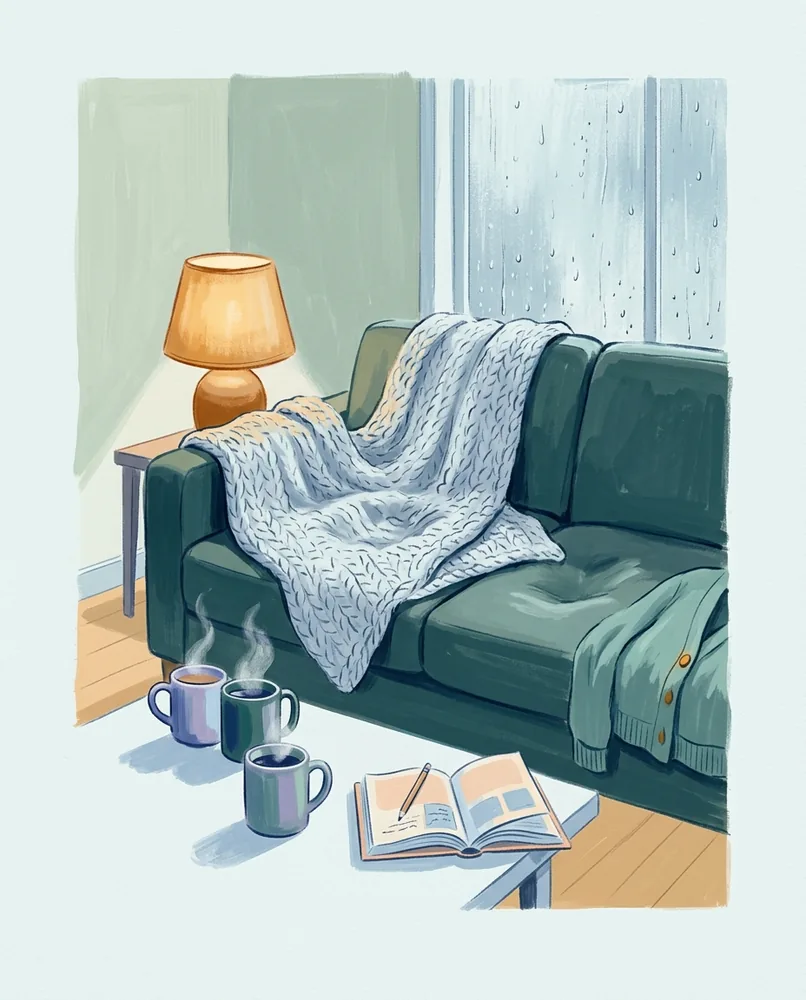
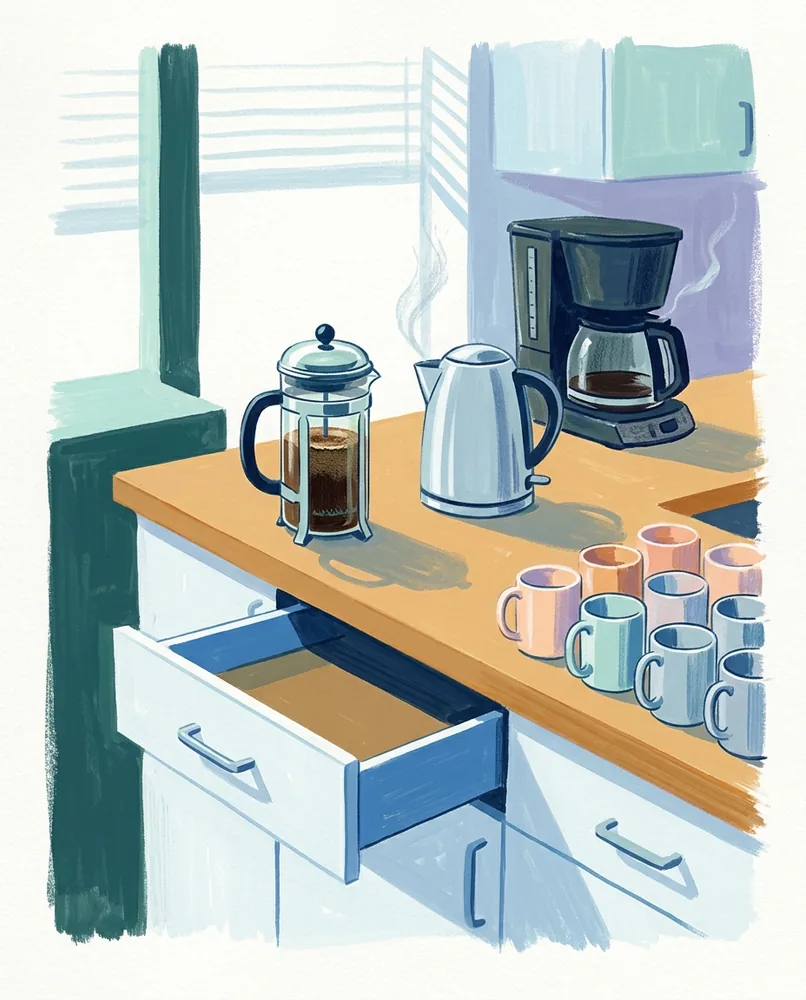
The Caretaker
The person who notices what could go wrong—and quietly brings what might help.
- Strength
- A safe place to land
- Watch for
- Yes before you’ve checked
Personality types
Explore sixteen personality types, each written as four letters such as ISFJ, with a name, a painting, and a full guide. Each letter shows which side of the middle a score falls on, while the score itself varies by degree, so a result near the middle could go either way. Read the guides or take the Personality Type assessment to find yours.

The Caretaker
The person who notices what could go wrong—and quietly brings what might help.
The Anchor
The person who notices what needs handling—and quietly handles it before it becomes everyone’s problem.
The Poet
Warm, low-key company for a few close people, with room for the day to unfold.
The Fixer
Happiest when you can work things out in real time, on your own terms—and change course as soon as reality proves the plan wrong.
The Beacon
Easy to talk to, slow to talk over anyone, and likely to remember what mattered after the conversation is over.
The Strategist
You can take an idea from private conviction to working reality without needing a crowd, permission, or constant encouragement.
The Dreamer
Someone who lets an idea wander until it reveals what it means—and may need a quiet nudge when wandering starts to replace arriving.
The Scholar
Ideas are invitations, not obligations. You may enjoy following a question through several surprising turns, even when the best outcome is a sharper question rather than a finished answer.
The Host
Friendly, attentive, and ready with the practical help that turns a group of people into a community.
The Organizer
The one who turns intention into action, gives a group a workable structure, and stays with the method until the job is done.
The Charmer
Warm, spontaneous, and ready to make an ordinary moment more alive.
The Daredevil
Ready to make the call out loud and on the spot—especially when something practical needs doing now.
The Mentor
Someone who says yes easily, gets things moving, and keeps adding ideas and people to the plan.
The Captain
Quick to turn a promising idea into a direction—and persistent enough to keep it moving when enthusiasm fades.
The Optimist
Easy to meet, quick to warm up, and energized by ideas—even when the plan is still taking shape.
The Innovator
Full of lively energy and ideas, quick to test a possibility, and often ready to move on once the interesting part is over.
Answer 50 statements to find which of the 16 types is yours. Then see how you work, how you are with people close to you, how you handle pressure, and where a strength can be hard for others.

Reference
Katharine Briggs and her daughter Isabel Briggs Myers developed the four-letter format and its eight letters in the mid-twentieth century, building on Carl Jung’s writing about psychological types. The format and the words are theirs.
Nomigram does not ask the original format’s questions or score its four preferences. Every letter here comes from one of the five trait scores from the personality questions on this site. Lower Extraversion gives I and higher gives E, lower Openness gives S and higher gives N, lower Agreeableness gives T and higher gives F, and lower Conscientiousness gives P and higher gives J. Emotional stability gives no letter, and a 1989 comparison by Robert McCrae and Paul Costa in the Journal of Personality, volume 57, issue 1, pages 17 to 40, with 267 men and 201 women aged 19 to 93, found that the four letter scales measure aspects of four of the five broad traits.
The same comparison found no support for separate camps on each letter or for people falling into qualitatively distinct types. People spread along the four traits by degrees. Nomigram marks each score with a dot on a line and shows its distance from the middle, so nobody is handed one of sixteen boxes. A letter near the middle can go the other way on a different day.
McCrae, R. R., & Costa, P. T., Jr. (1989). Journal of Personality, 57(1), 17–40. DOI
Each pair of letters comes from one of the five traits, worked out from the same answers as your personality report. A score near the 50th percentile is a close call; a score at least 25 points from the middle is a strong lean.
Emotional stability, the fifth trait, doesn’t feed any letter. You’ll still find it in your personality report, where it adds important context to how the other tendencies may feel in daily life.
Each letter comes from one score that runs by degrees from one end to the other, and the letter tells you which side of the middle the score fell on. The letters describe tendencies, so they do not put you in a box. When researchers compared four-letter codes with the five traits, they found that people spread out along each scale by degrees instead of separating into distinct types. A result close to the midpoint may be especially worth noticing because it can give you access to both sides, depending on the setting, the people involved, or what the moment requires.
You can read any of them, and a letter that came out nearly tied can make two types sound right. But the type is not meant to be a personality label you choose because its description feels flattering or familiar. Your letters come from your answers to the Personality Type assessment: four trait scores are each compared with the midpoint, then translated into the letter on the side where you landed. A result near the midpoint can resemble both sides, while a result far from it usually makes one preference more noticeable. Taking the assessment is the best way to find your letters; reading the types afterward is the best way to explore what those letters might mean in your life.
The four-letter types here are related to results often presented as MBTI types from the Myers-Briggs Type Indicator or as 16Personalities results. Nomigram reads each type from five trait scores, the traits researchers call the Big Five. Four letters come from Extraversion, Openness, Agreeableness, and Conscientiousness, while Emotional stability is reported separately. A type found elsewhere may differ because each assessment uses its own questions and scoring.
Nomigram is not affiliated with, endorsed by or sponsored by the Myers & Briggs Foundation, The Myers-Briggs Company or NERIS Analytics Limited, and the names are used here only to explain how our assessments relate to them. MBTI, Myers-Briggs and Myers-Briggs Type Indicator are trademarks or registered trademarks of the Myers & Briggs Foundation, Inc. in the United States and other countries. 16Personalities is a trademark of NERIS Analytics Limited.