Types / Six traits / Openness

One trait, four facets

Openness

How much you seek beauty, ideas, imagination, and ways of seeing the world beyond convention.

What Openness measures

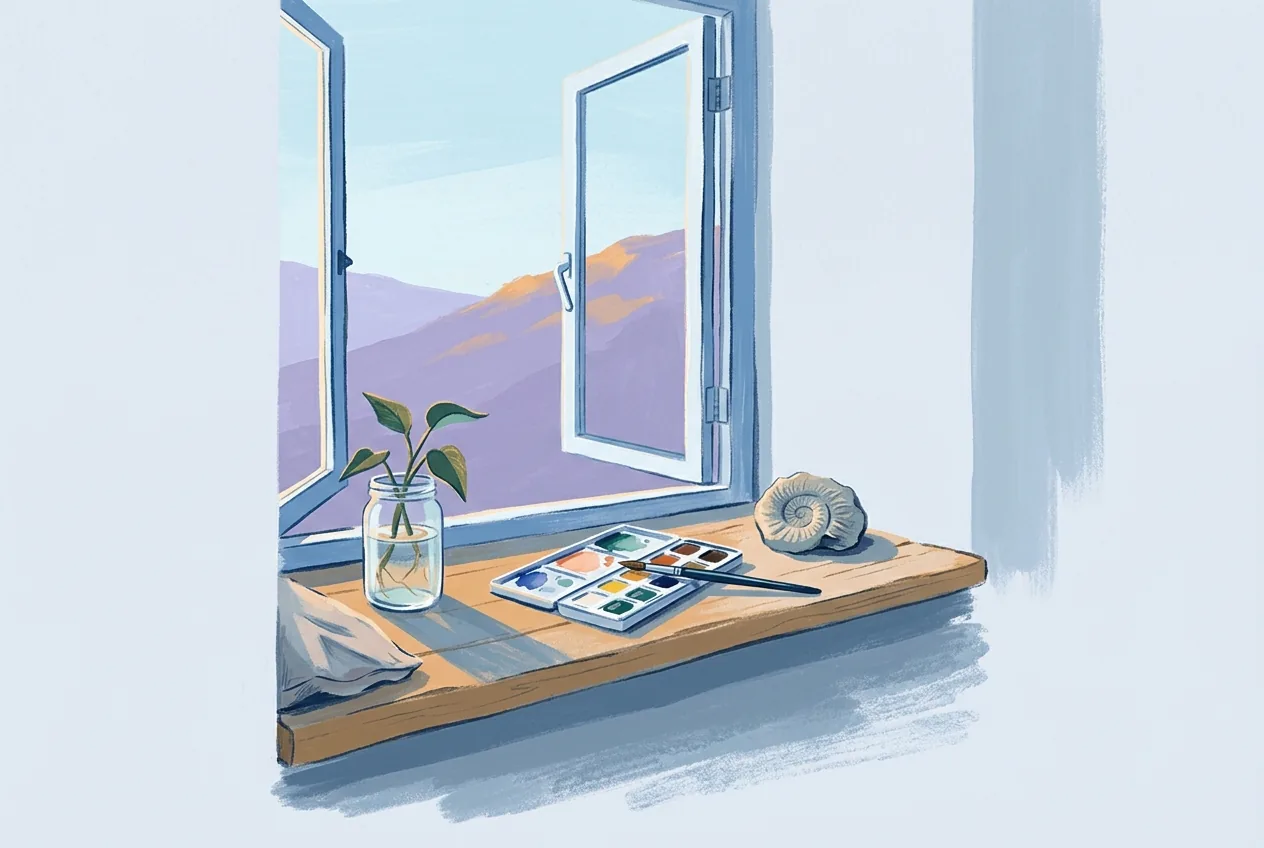
A wide window opens onto a hillside above a sill holding a plant cutting in water, a paintbrush, and a fist-sized fossil.

Openness asks how much a person is drawn to ideas, beauty, imagination, and unfamiliar ways of seeing things. It appears in responses to art, abstract questions, unusual experiences, and possibilities that have no immediate practical use. Someone at the lower end often trusts established methods and concrete results. Someone at the higher end often explores alternatives before deciding what deserves a place.

Its four facets show what kind of openness is involved. Art and beauty concerns aesthetic attention, Curiosity concerns interest in ideas, Imagination concerns inner possibilities, and Unconventionality concerns willingness to question familiar assumptions. Together, they describe a style of noticing and thinking. They don’t decide whether an idea is useful or whether a tradition is worth keeping.

The two ends

This is a scale, not two camps. Most people land somewhere between the ends, and neither end is better. Each describes a different way of responding, with useful qualities and possible costs.

More drawn to what works

People answering toward this end often favor familiar methods, practical evidence, and ideas that have already proved useful. They can make sound decisions without chasing every possibility, though a strong preference for what works can leave less time for exploration or imaginative alternatives.

More drawn to new possibilities

People answering toward this end often notice beauty, pursue questions, imagine alternatives, and entertain unfamiliar viewpoints. Their curiosity can produce fresh connections and more than one workable path. The same openness can scatter attention, make settled answers feel premature, or give intriguing possibilities more weight than practical limits deserve.

The facets of Openness

Openness is the average of these four facets. Somebody can land high on one and low on another, so the broad trait can contain a mixed pattern.

  • Art and beauty

    How much art, music, poetry, nature, and other forms of beauty move you.

  • Curiosity

    How much science, history, politics, challenging reading, and exploration draw your attention.

  • Imagination

    How much you use vivid imagination, generate new ideas, and look for different ways to do things.

  • Unconventionality

    How much you prefer your own way of seeing things instead of following convention.

How it lines up with five

See all five traits →

Openness lines up plainly with the same broad pattern of curiosity, imagination, aesthetic attention, and willingness to question convention. The six-trait wording divides that pattern into Art and beauty, Curiosity, Imagination, and Unconventionality, while a five-trait reading usually gathers them under one broad trait. The central meaning remains closely aligned.

This section is our reading of how the traits relate, not a research finding about every individual result.

The other traits

All six traits →

See your Openness result

The assessment has 240 statements. It returns a score for this trait and a separate view of its four facets.

Questions

Is a higher score better?

No. Each end comes with something that helps and something that gets in the way, and where a person lands describes a preference instead of a grade. Honesty and humility and Agreeableness have lower ends that people can read as judgments, so neither end deserves praise or blame.

Does a low score mean someone is dishonest?

No. The statements ask how somebody describes themselves, which isn’t a record of what they do. There is no cut-off and no verdict on anybody’s character. Nothing here should decide whether to trust, hire, or believe a person.

Where does this come from?

The statements are public domain and come from the International Personality Item Pool[1]. The 24 facet scales were published in 2007[2]. A result is compared with 460 adults of the Eugene-Springfield Community Sample who answered all 240 statements by mail between 1994 and 2003. The group’s own answers give the average, the typical range and the percentile.

  • 1 Goldberg, L. R., Johnson, J. A., Eber, H. W., Hogan, R., Ashton, M. C., Cloninger, C. R., et al. (2006). The international personality item pool and the future of public-domain personality measures. Journal of Research in Personality, 40, 84–96.
  • 2 Ashton, M. C., Lee, K., & Goldberg, L. R. (2007). The IPIP–HEXACO scales: An alternative, public-domain measure of the personality constructs in the HEXACO model. Personality and Individual Differences, 42, 1515–1526. Link